About the lake
A real place, and the game it turned into
Lake Monomonac sits on the Massachusetts–New Hampshire line, half in Winchendon and half in Rindge. It's about two miles long. There's no marina and no boardwalk — it's a hidden gem, and the people who summer there like it that way.
I've been going for over a decade. This game is what came of that.
The shoreline is the real shoreline
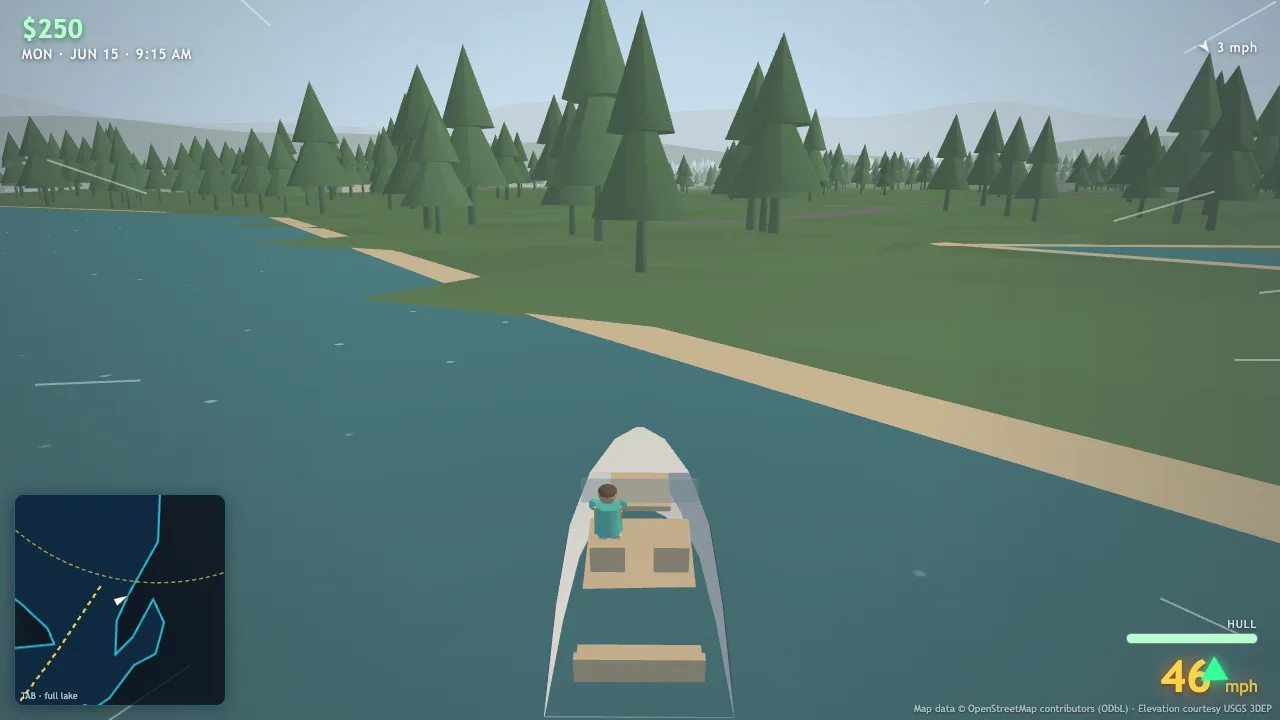
The lake in the game isn't a lake I drew. It's built from OpenStreetMap geometry — the actual outline of the water, all six islands where they actually sit, the real roads with their real names, and 789 buildings standing where they really stand. The elevation under all of it comes from the USGS 3D Elevation Program.
That decision drives almost everything else. Because the map is real, the water has to behave like that water: the collision system builds a signed distance field of the whole lake at load, so the boat slows in the shallows off the right points and the islands are in your way exactly where they'd be in your way. People who know the lake find their own dock. That's the part I most wanted to get right.
Everything on top of it is invented
The summer of 1987 never happened here. Uncle Ray isn't anyone. The rivals, the businesses, the households, the camp, the races — all of it is made up, and no real person is depicted in the game. The houses are where the houses are, but whoever lives in them in the game is fiction, generated from the building's map ID and nothing else.
I think that's the honest way to make a game about somewhere real: get the geography exactly right, and invent everyone.
Why 1987, and why an arcade
A simulator would have been the wrong answer. What I wanted to capture isn't how a boat handles — it's what a lake summer felt like: the whole day ahead of you, the radio on, somebody's ski rope in the back, and the vague sense that if you were fast enough you'd be somebody by Labor Day.
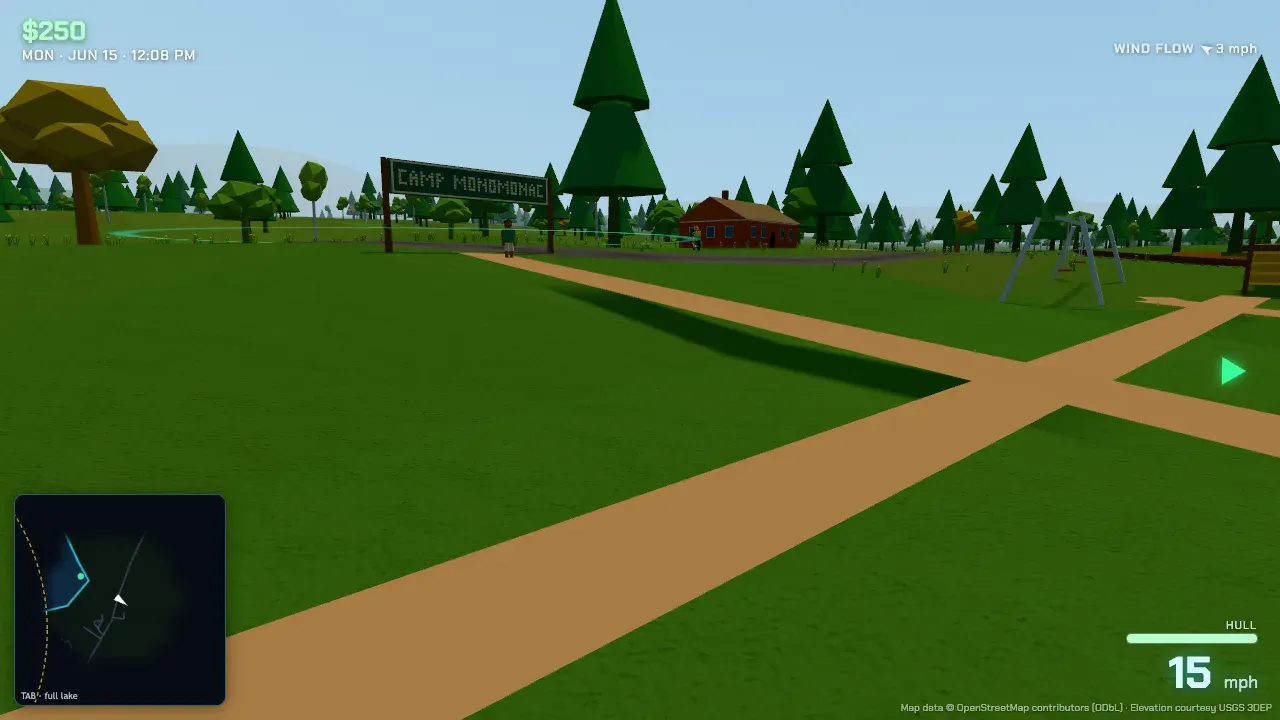
So it's an arcade game, and it's set in a summer that looks like the one a kid in 1987 would have imagined. Flat colors, hard shadows, neon on the race gantry, and a boat that planes when you bury the throttle. Days run about twelve real minutes. There are six radio stations. The sun goes down properly.
It also means the summer has room for more than racing. You can be a counselor at the camp on a Tuesday, run a grocery list for a neighbor on Wednesday, tow a skier through the slalom on Thursday, and still be on the start line Saturday morning trying to build a name for yourself. That combination — an ordinary summer job and a racing reputation, in the same twelve weeks — is the game.
Made in code, on purpose
Almost nothing in the game is a drawn asset. The boat hulls are lofted from station curves in code, the trees and water and sky are generated, the sound effects are Web Audio oscillators and noise, and the building colors come from a palette rather than from photography. The exceptions are documented in the credits: the radio songs, a handful of voice lines, the character rig, the display font, and the character portraits.
Everything the game needs ships with it — no streaming assets, no game server, no account. You click it and you're on the water. (Production builds do send anonymous gameplay telemetry; what that covers is spelled out in the privacy policy.)
Why it exists
Because I love this lake, and it's a hidden gem.
Every summer I'd end up describing it to someone and never quite land it — it's small, it's quiet, it's split across a state line, and there's genuinely nothing famous about it. Building it turned out to be an easier way to explain what it's like than talking about it ever was. If you've never been, this is the closest I can get you. If you have, you already know which dock is which.
Built out of love · David Graves
Lake Monomonac is a fictional video game inspired by life on the real Lake Monomonac (Winchendon, Mass. / Rindge, N.H.). The shoreline and buildings are mapped from real data; every resident, business, and event is invented, and no real person is depicted.